
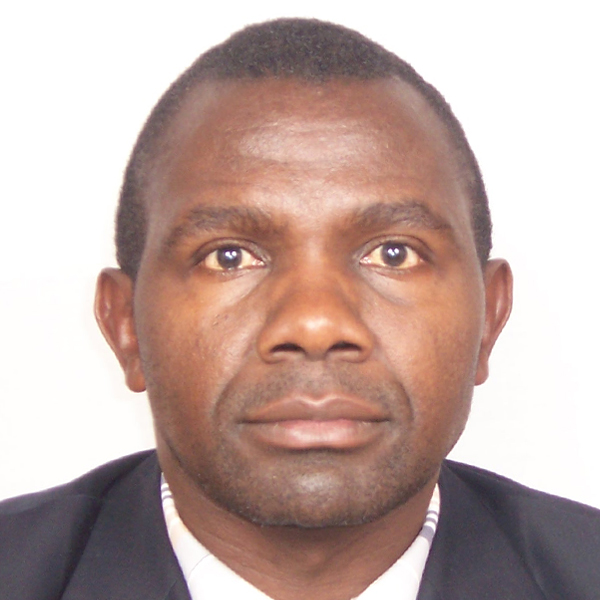
Dr. Kelvin Khisa is the current acting Director General of the Kenya Industrial Research and Development Institute (KIRDI). He holds a PhD in Environmental Policy from the University of Nairobi, a Master of Philosophy Degree in Environmental Science from Moi University, and a Bachelor of Education Science Degree in Chemistry and Mathematics from Kenyatta University. Before his elevation, he served as a Principal Research Scientist with the Environmental Sustainability and Climate Change Research Center (ESCC-RC). His research interests are in the broader areas of Resource Efficient Cleaner Production (RECP) and Green/ Circular Economy innovation promotion for improved productivity and competitiveness of Industry. The scope of his research work entails constantly exploring innovative ways of advancing a resource efficient, green and circular economy development trajectory for the Kenyan manufacturing sector with the ultimate aim of enabling these industries to decouple their economic growth from excessive resource consumption. This adopted resource efficient circular economy approach is restorative and regenerative by design, and seeks to keep materials, products, and components in repetitive technical and biological closed loops, maintaining them at their highest utility and value at all times. It is an alternative to the current wasteful ‘linear economy’, that is synonymous with the ‘take-make-waste’ approach to the production of goods and services. On the contrary, the Circular Economy is based on the “make-use-and-return” model that is systemic by design, close-looped, restorative, waste-free, and runs largely on renewable energy.
Apart from promoting the adoption of the four circular economy principles and five circular business models, I also offer technical support to Kenyan County Governments to enable them adopt a combination of different strategies that will help foster an accelerated adoption of green and circular economy innovations within their upcoming industrial parks with a focus on Promoting higher renewable energy generation and use, with a view to achieving carbon neutrality; Keeping materials and resources in use at the park level by encouraging tenant firms to create a symbiotic network and enabling their waste and by-products to be exchanged; Designing waste out by encouraging tenant firms to integrate circular designs and to use environmentally friendly technologies in their production facilities; Fostering the establishment of recycling enterprises and sorting facilities rendering services to tenant firms; Rethinking business models to incorporate circular business models for purposes of improved energy, water, and waste management at the park level; and Harnessing digital technologies to help increase resource circularity and material exchange.